To label, or not to label, that is the question

Over the years I have met a great many parents whom, at one time or another, have faced this particular dilemma. They have come to realise that their child is struggling at school, and they have begun to take those first tentative (but necessary) steps towards seeking some kind of help and support.

In my experience, when a group of parents get together over a coffee, the conversation usually adheres to a common theme – that of parental self-deprecation (after all, how many people honestly think that they are ‘acing’ this particular role?!) interwoven with the fundamental reality that most of us just want our children to ‘fit in’, be happy and to achieve their true potential. And it’s incredibly difficult to accept when something ‘isn’t quite right’. Feelings of inadequacy and anxiety begin to surface, and it can take a while for us to work through our own emotions, let alone ready ourselves for the inevitable challenges that we will need to help our children to overcome.

Society as a whole, of course, offers very little encouragement here.

As demonstrated by some of the abhorrent behaviour surrounding England’s defeat at Euro 2020, prejudice is evidently still very much alive and well. Whether pertaining to race, sexuality, age, or religion it would seem that ‘equality’ is the luxury of the few and there needs to be a concerted effort to change this. And like it or not, with every educational / behavioural diagnosis comes a certain amount of stigma too and (whilst progress is undoubtedly being made to address this) one can understand why a parent might be reluctant to authorise a comprehensive assessment for their child, for fear of them being ‘labelled’ and therefore viewed differently from their peers.

I remember taking part in an INSET session some eight or nine years ago that was looking at the common signs of, and useful strategies to help, those children with Autistic Spectrum Disorder (ASD). Being a subject that genuinely interested me, I had (rather uncharacteristically) listened intently – and made copious notes too! And just as I was beginning to wonder if my child might actually be ‘on the spectrum’ too, the presenter explained that most children under the age of five would exhibit a number of the behaviours outlined and that the mean age for ASD diagnosis ranged between 38 and 120 months. My relief was palpable (the proverbial weight having been lifted from my shoulders) and I settled down gratefully to the paediatric first aid course that followed.

All these years later, I have come to realise that my reaction was ‘normal’ (but also incredibly short-sighted) and this has made me much more empathetic towards those awaiting the diagnosis of a specific educational need for their child. The very notion that one’s treasured offspring might not be able to access education (or understand social convention) in the ‘usual’ way can be difficult to accept, and it is not uncommon for parents to feel a degree of culpability either – unwarranted or otherwise.

However, I wonder if an analogy with the labelling found on an item of clothing might be worth some consideration here? After all, without such a label there is a real chance that a particular item of clothing might become damaged or (in the event of it being dramatically reduced in size) rendered utterly worthless to the wearer. By attaching a ‘care’ label to a child then (rather than simply viewing that label as a set of arbitrary instructions) there’s a strong chance that this might help to alleviate some of their feelings of confusion and inadequacy. And better still, you might just be furnishing your child with an enduring sense of self-worth too.

I’m with Confucius on this one!

English Proverbs have long held a certain amount of fascination for me, and I used to love hearing my mum refer to a large number of them as she went about her daily tasks. Coping with six children cannot have been without its challenges, but she was incredibly adept at finding a saying that would put a positive slant on an otherwise demanding situation.

I’m quite sure, however, that in our case (my mum being constantly surrounded by a veritable gaggle of ankle biters) ‘Too many cooks spoil the broth’ might have been rather more apt than ‘Many hands make light work’ and this is possibly why she became a staunch believer in ‘Making hay while the sun shines’ – or at least before any of her ‘little darlings’ had had the chance to surface!

What I really love about all these sayings though are the many straightforward messages of wisdom and morality that they help to impart, in language that is rather less condemnatory than some of the statements found within the scriptures of the Old Testament. Take, for example, Proverbs 1:32-33 “For the waywardness of the simple will kill them, and the complacency of fools will destroy them; but whoever listens to me will live in safety and be at ease, without fear of harm”. This is pretty uncompromising stuff! A case of ‘my way or the highway’ perhaps?

As with so many popular sayings though, it is usually possible to find another one that conveniently provides a ready-made counter argument.

‘Absence makes the heart grow fonder’ can neatly be substituted for ‘Out of sight, out of mind’ depending upon the mood of the protagonist. Similarly, ‘Great minds think alike’ can be turned upon its head with the maxim that ‘Fools rarely differ’! And, being an unashamed devotee of language, I often find myself marvelling at the astonishing power of words to empower or defeat, comfort or wound, entertain or reduce to tears.

Confucius was a Chinese philosopher and politician who was generally considered to be the ‘paragon of Chinese sages’. Born in 551 BC, Confucius lived until he was 71 and during that time, he gained a reputation for striving to make education broadly available, and for establishing the art of teaching as a much-respected vocation. His ‘golden rule’: “Do not impose on others what you do not wish for yourself’ would seem to offer a moral code fit for all and one that requires no further explanation. For this reason (and because I am still working my way steadily through a mid-life crisis of my own) I decided to find out what Confucius had to say on the subject of old age. The results were surprisingly encouraging…

“Old age, believe me, is a good and pleasant thing. It is true you are gently shouldered off the stage, but then you are given such a comfortable front stall as spectator.”

Perhaps it’s time to let the youngsters take centre stage, and for me to settle gratefully into my seat, with a substantial container of popcorn at the ready!

What doesn’t kill you…

I’ve touched upon the subject of ‘resilience’ before, and I’m willing to bet that the vast majority of us will have been forced to develop this ‘in spades’, following confirmation that the UK’s first case of COVID-19 had been recorded on 31st January 2020.  

However, ‘Risk and Resilience’ has long been a focus for businesses around the globe, both in terms of determining technological or financial vulnerability, and assessing the extent to which teams of employees possess the emotional resilience to deal with a range of challenges.

The popular saying ‘What doesn’t kill you makes you stronger’ (albeit originally rather more eloquently expressed by the German philosopher Friedrich Nietzsche) is one that I am particularly fond of uttering, and I don’t mind admitting that (at least nine times out of ten) it is accompanied by a cursory rolling of the eyes too! The very notion that the only feasible alternative to ‘coping’ with the additional stress of a challenging situation is ‘certain death’ would (to my mind at least) seem to be a rather extreme means of testing one’s adaptability. And anyway, ‘broad shoulders’ are arguably something best left condemned to the 1980s…

On the other hand, it could be argued that it is only by ‘pushing the boundaries’ that we learn the true extent of our capabilities and there is definitely something to be said for trying new things and embracing fresh challenges from time to time.

Last Sunday, we ventured once again to our happy place.

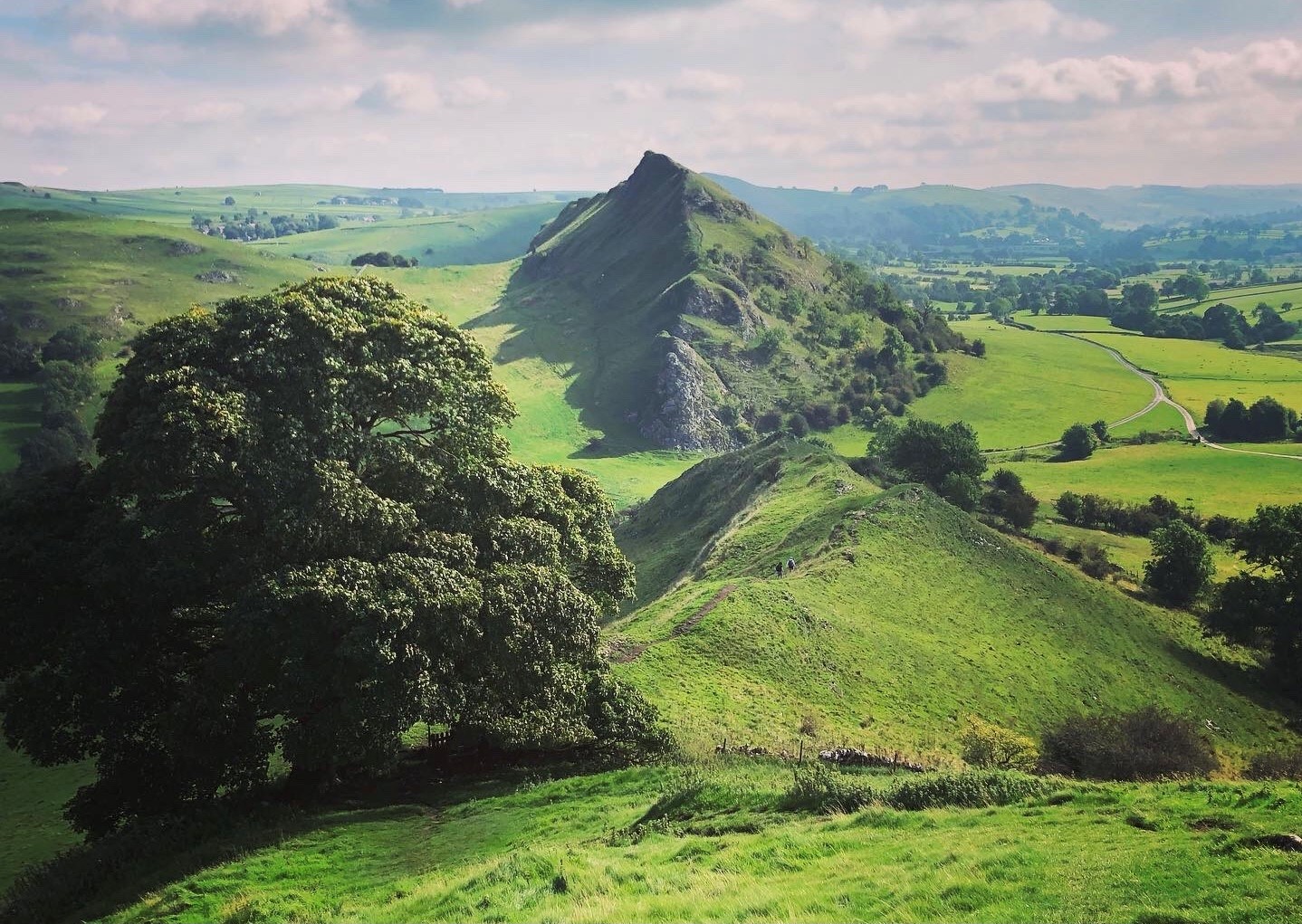
The Peak District (with its steep limestone valleys, dramatic gritstone ridges and stark moorlands) never fails to provide us with some much-needed breathing space, and our boys love nothing more than to scramble unreservedly amongst the numerous rocky outcrops. Having first consulted ‘ViewRanger’ (our Sunday app of choice) we had chosen a circular walk in the Upper Dove valley area of the Peak District taking in a line of pinnacles said to resemble the ‘plates’ along the spine of either a dragon or a dinosaur. The very mention of such dramatic imagery certainly piqued the interest of our youngest and it was with great relish, therefore, that he scampered ahead like the proverbial mountain goat.

Very quickly the going became incredibly tough with steep inclines, scant paths, and a variety of uneven surfaces that had a habit of crumbling at the most inopportune moments. Two legs were quickly exchanged for ‘all fours’ as we kept our centre of gravity close to the ground and (desperately clutching at anything that might lend some kind of support) leaned into the mountain in a fervent attempt to steady not just our bodies, but also our nerves.

Needless to say, with several more pinnacles still to navigate, this was an ordeal that was to be repeated more than once and I’ll admit to succumbing to brief periods of panic each time our boys vanished from view. I needn’t have worried though, because they were infinitely more agile than either of their parents – and in their element at being able to assist their old and feeble mum in her increasingly tentative attempts to conquer the rugged terrain.

We were ultimately rewarded with spectacular views, looks of admiration (from seasoned hikers with rather more specialist equipment than the humble trainers that we were sporting) and a well-earned (and deliciously peppery) pasty at the summit. Even the boys agreed that this was a winning combination, worthy of deserting the Xbox for a few hours at least. High praise indeed!

Once we were safely back at our car, the journey home offered ample opportunity for quiet reflection. Stiff legs and a sense of elation were proof enough that some risks are definitely worth taking.

And the best bit? ‘Death’ was cheated out of one more day!

Significant milestones

Language evolution is something that has always fascinated me and so I decided to take a look at some of the main motivating factors.

To a certain extent, the language that we use reflects both our environment and those with whom we interact. If we think back to the days of colonialism, there would have been a necessity to find a way to communicate with other populations for the purposes of trade. Similarly, technological advancement has had a huge part to play in the introduction of new vocabulary as people have striven to find innovative ways to talk about these exciting developments.

It has also been suggested that a sort of ‘Linguistic drift’ tends to occur when language is passed down the generations. As a result, our pronunciation changes, new words are invented, and the meaning of old words can begin to shift too. And whilst I’m entirely in favour of working at broadening my vocabulary, I have to admit to having been rather affronted by the quasi canonisation of certain ‘new’ words by the Oxford Dictionary. Take, for example, the word ‘fitspo’, short for ‘fitspiration’. I mean, really? What hope does this kind of madness offer me for remaining undefeated in the family ‘Scrabble’ games of the future?!

One example of a word that has undergone a gradual shift in meaning is ‘milestone’.

Originally a ‘stone set up beside a road to mark the distance in miles to a particular place’ this term is now used as a means of marking a significant life event. And whether it is within the context of childhood development, or the lifetime ‘firsts’ commonly celebrated by adults, a degree of both pride and joy is traditionally shared amongst friends and family alike.

Is it just a happy coincidence then, that this article marks not only my 1st anniversary as a blogger, but also my 50th blog?

Of course not. And, like so many personal achievements, this particular milestone has only been made possible by the support and encouragement of those around me.

My sincere thanks for taking the time to read this and (more importantly) please do stick around for the next fifty!         

What does your ‘11 o’clock number’ say about you?

How many times have you uttered the words “I wish someone had told me that before” – or something similar? The truth is, of course, that they probably did – it’s just that you might not have been all that receptive at the time…

That’s the unfortunate thing about ‘advice’. It’s frequently offered where none was in fact sought and, even if it was, there’s a strong chance that anything remotely unpalatable will have been instantly cast aside. But there’s also something to be said for being ‘allowed’ to make your own mistakes and I sometimes wonder if (by advocating the type of ‘helicopter parenting’ frequently demonstrated on Facebook) we are in fact depriving our children of the opportunity for developing some good old-fashioned resilience?

Over the years I must have taught hundreds of songs (from a wide range of genres, and to pupils of all ages) but by far the most popular ones have been those plucked straight from the world of musical theatre. So, what is it about the humble musical that has made it such an enduring hit?

Perhaps it’s

  • The instantly singable tunes – suited to crowded auditoriums and compact shower cubicles alike
  • The license for (over) sharing of emotion – who doesn’t love a diva?!
  • The spectacle – ‘The Lion King’ definitely springs to mind here, with its breath-taking 18-foot exotic giraffe puppets
  • The escapism – often much needed at the end of the working week
  • A combination of the above

Whatever the draw, this particular art form continues to enjoy a tremendous level of popularity, and this got me thinking about the so-called ’11 o’clock number’. This is a theatre term used for a show-stopping song that occurs late in the final act of a musical. It is traditionally sung by the main character and marks the point at which they reach an important realisation.

Looking back to my early thirties, I’m almost certain that ‘Defying Gravity’ would have been mine. I was confident, determined, and headstrong and I had a very clear idea of what I wanted from life. More than a decade later (and valuing family, health and happiness over career, status, and wealth) I fear that my 11 o’clock number might be rather different now…

I’m going to go with ‘Sit down you’re rockin’ the boat’ – in recognition of my unashamed desire to slip under the radar and avoid any unnecessary conflict. Anything for an easy life really!

So, how about you?    

Would you rather

I wonder just how many of us have, at one time or another, resorted to playing the odd game of ‘Would you rather?’ in an attempt to kill some time? I know that we’ve played it on numerous occasions (whilst stuck in traffic or seated at a restaurant, waiting for our food to arrive) and it always fascinates me to see just how much of a quandary can be sparked by a handful of seemingly innocuous choices.

Rather quickly, a picture begins to emerge as to the personality traits and priorities of each player and the rationale behind some of the decisions (in our household at least) has been nothing short of hilarious at times.

And so, in deference to that tension dispersing, mood enhancing, sanity saving family rescue tool, here are my (somewhat irreverent) thoughts as to what the workplace equivalent might look like:

‘Would you rather’ by Gaynor Hall

Would you rather wear a tutu or a wetsuit to the office?
Or carefully don a crisp white veil and pretend to be a novice?

Would you rather commute by bicycle, by skateboard or on foot?
Or travel along the floo networks of Rowling’s wizarding books?
 
Would you rather clean the staffroom fridge, or fix the photocopier?  
Neither one sounds tempting, but with which would you be happier?

Would you rather get a pay rise, or a boost in annual leave?
Or maybe just an amnesty on the 100+ emails received?

Would you rather date your manager, or perhaps the boss’s son?
Exactly how far would you go to get that promotion won?

Would you rather have an argument, or staunchly bite your tongue?
Is hot-headedness in the workplace just the dominion of the young?

Would you rather court the limelight, or support from behind the scenes?
How important is it to you that you get to chase your dreams?

Would you rather be a leader, or perhaps a keen foot soldier?
Do you value your family time much more, now you’re getting older?

Would you rather inspire fear, or try to keep an open door?
Does it make good sense to perpetuate the misery of before?

Would you rather leave behind you a sense of loss, or of relief?
Or perhaps, like me, you’d rather be known for humour and mischief!

Steely, with a hint of flamboyance

Celebrities, much like us lesser mortals, come in many different guises. Some instantly attract our attention (engendering feelings of admiration and respect) whilst others make less of an impression, failing to engage with us on a more personal level.

My staunch inability to identify even the most notable of ‘household names’ has (over the years) become a source of utter bewilderment to my husband, but I’ve reached the conclusion that I’m just not that good at remembering the names of those whom I haven’t actually met.  And besides, I’ve reached that age when managing to stay awake for an entire evening’s viewing poses a significant challenge!

Some celebrities are not quite as easy to forget though and names such as Morgan, Paxman and Clarkson seem to invite the sort of ‘love-it-or-hate-it’ response previously only associated with the tag line of a certain yeast extract spread. And despite having only watched a handful of ‘Top Gear’ episodes (in the days when I could stay awake for 60 minutes at a time and felt compelled to at least try to share in my hubby’s passion for performance cars and dangerous antics) Jeremy Clarkson certainly made an impression with his cavalier comments, dry wit, and proclivity for causing offence.

Having trained as a journalist, secured various roles as a motoring columnist, and written several humorous books about cars it was no real surprise that Clarkson cemented his reputation as something of a ‘petrolhead’.  However, his decision to buy an arable farm in the Cotswolds in 2008 (and then to take over its management in 2019 with no previous experience of farming) was rather less predictable – although his decision to rename it ‘Diddly Squat’ (owing to its lack of productivity) was certainly in keeping with his penchant for self-deprecating remarks. His decision to make the project into a documentary was, of course, pure genius.

Almost inevitably, Clarkson’s Farm achieved the highest viewer ratings of any Amazon Video production with fans seemingly lapping up the way in which Clarkson (aided by the clever editing of Andy Wilman) had managed to bring entertainment and humour to the topic of farming. However, in true Clarkson style, his latest project has courted a great deal of controversy too. Whilst many of us have simply enjoyed being a ‘fly on the wall’ (watching his exploits from the comfort of our own homes) the locals have seen their hitherto delightfully sleepy and picturesque village turned into a major tourist attraction, complete with crowds and queuing traffic.

I can only imagine the tone that was set at the meeting that he recently called in order (purportedly) to assuage the fears of the local community in Chadlington. Known for his straight-talking and uncompromising approach I suspect that he was simply ‘setting out his stall’ so that the rumour mill might simply have a little more substance to it. Either way, when it was mentioned earlier this week (on Heart’s Breakfast Show) that Jeremy Clarkson (in addition to opening a restaurant) might be planning to plant grapevines with a view to producing his own wine, all sorts of questions began to assemble:

  • Which variety of grape might he choose?
  • What might it taste like?
  • Would it be as successful as the rest of his produce?

And in much the same way as a pet’s appearance is widely believed to resemble its owner, I wondered if this particular wine might reflect the personality of its producer:

‘Steely, with a hint of flamboyance’ perhaps, ‘with mild tones of unpalatability’?   

Striking out

The start of any new chapter inevitably brings with it a glut of conflicting emotions, but it’s how we channel those emotions that ultimately sets the tone for what happens next.

I’ve mentioned before that (rather regrettably) my default setting would seem to be that of a ‘glass half empty’ sort of person. This is possibly why I am prone to dwelling upon all of the things that didn’t go so well, rather than simply deriving pleasure from those that did.

With this in mind, I am trying hard to gradually adjust my mindset, in the hope of becoming a better role model for my children whilst also improving my own sense of wellbeing. [I’m also painfully aware that the saying ‘Do as I say, not as I do’ (quite apart from being laced with hypocrisy) seems woefully inadequate – and would only invite all sorts of unpalatable comebacks, the likes of which I am eager to avoid!]

‘Striking out’ by Gaynor Hall

Dwell not upon what went before – it’s better left behind,
You’ve got a bigger project now, an exciting future to find.
By all means use what you have learned to fashion out a path
That furnishes you with everything you’ll need to help you laugh.

Hold close those friends that matter, be mindful every day
Of those who’ve had a part to play in helping you on your way.
Be brave and view each challenge as a chance to show the world
That you are like a silken flag just waiting to be unfurled.

Don’t shy away from difficult tasks, use every ounce of wit
To meet each obstacle head on, until you’ve conquered it.
Try to view each worry, each failure or fresh doubt
As a means of growing stronger – success turned inside out.

Follow your convictions, hold true and don’t be swayed
By those who’d see you falter just to quash their own malaise.
Extend the arm of friendship to those who need it most,
Be proud of your achievements but reject the need to boast.

Approach each day with honesty, compassion, and good humour –
Resist the urge to inflict harm by fuelling vicious rumour.
Remember that your legacy (when all is said and done)
Is the meaning that your life has brought to the memories that live on.

New chapters

First days are seldom easy and, regardless of the setting, there always seem to be a fair few hurdles to climb. Most of us do ultimately survive them though, and the general consensus is that ‘things will get easier’ as time goes on.

With secondary schools starting back this week, there will no doubt be a large number of Year 7 children who feel incredibly nervous. This poem is for them. Be brave, be positive – and please know that ‘lunch’ is sometimes still the highlight of my day! 

‘First day nerves’ by Gaynor Hall

The waiting’s almost over, there’s only a few hours left,
The Summer passed so quickly, he hardly caught his breath,
Uniform named and ready, school bag neatly packed,
Bus route walked and memorised, timed both there and back.

He knows this is just the way of things, done countless times before,
By children who’ve felt just as scared as him when they stepped from their front door,
And yet a hundred butterflies seem to dance inside his belly,
What he wouldn’t give for one more day snuggled up in front of the telly!

The bus arrives, he scrambles on, not sure quite where to sit,
And then he spots an empty seat and gratefully seizes it.
He watches as the trees go by and drizzle strikes the window,
Relieved to have managed at least one ‘tick’ in this game of first day bingo.

The bus departs and the day begins with numerous introductions,
Each member of staff (all nice enough) reeling off a host of instructions.
He feels his head begin to spin and starts to get a hunch –
That the highlight of today, at least, might end up being lunch.

With his stomach full (and old friends found) he feels his spirits swell,
Just Art and History still to come and then the final bell.
The journey home flies quickly by, there’s a spring in this young man’s step,
What a shame that it’s only Monday then; there’s a while ‘til the weekend yet!

Defying belief!

Most people will be familiar with the phrase “Never work with children or animals” coined by W.C. Fields all those years ago. However, I’m willing to bet that (following an extended period of COVID driven home schooling) an even greater proportion of adults now have a better understanding of the potential pitfalls of even trying to achieve something useful whilst the ‘ankle biters’ are around!

As a mum of boys, I discovered quite early on that my children needed ‘exercising’ in almost the same way as a dog. Any fleeting thoughts of spending a ‘lazy day at home’ were usually swiftly dispersed upon realising that there would almost certainly be ‘pay back’ – in one form or another. If we were lucky, it might simply be under the guise of incessant bickering and the joyful refrain of “it’s not fair!” being emphatically chorused on auto repeat. On a bad day though, the afore mentioned arguments and protests would gradually escalate into the damaging of toys, furniture, or (much to my husband’s annoyance) the paintwork. And so, a genuine love of the great outdoors developed (amongst their parents at least) and with it, tangible improvements to behaviour, sleep quality – and (I’ll admit it) home décor!

Having moved to Derbyshire in 2014 we have been fortunate enough to have acquired an enormous natural playground, right on our doorstep. Many a Sunday is spent happily exploring the astonishing beauty of the rugged terrain and majestic rocky outcrops of the awe-inspiring Peak District. Bracing climbs and spectacular views do wonders for one’s physical and mental wellbeing and only the most appalling weather conditions can generally dissuade us from heading out there.

Shortly after Christmas then, ever mindful of the usual post-turkey resolutions, we took the decision to brave the snow and head out to the Peaks. We had chosen a circular walk from ‘The Fox House’ in Longshaw and (at just over 4 miles and supposedly well within our capabilities) headed confidently in the direction of Higger Tor.

All went well to begin with, both boys happily running ahead and delighting in trying to shatter some large sheets of ice that were dotted about at the edge of the trail. In no time at all we had reached the first proper ascent, stopping only to watch a handful of intrepid motorists do battle with some horribly icy country lanes. As we picked our way carefully amongst the rocks, my husband became aware that his phone battery was almost flat and that since this was our only means of navigation (coupled with the fact that an ominous mist was threatening to obscure the landscape altogether) there might be genuine cause for concern. Without a feasible alternative though, there was no real choice but to carry on – and besides, our youngest was making short shrift of the rocky ascent, emulating only the most experienced of mountain goats!

Eventually, (and after an undignified fall on my part that ironically followed a plea to ‘be careful’ to my two infinitely more agile children!) we reached the summit and discussed the quickest route down. The snow had fallen more heavily on that side of the tor and so it was quite difficult to gauge (with any certainty) what lay below. The mist was closing in more rapidly now too and so we promptly chose our ‘path’ and began our descent.

Having negotiated countless twists and turns (largely of my ankle joints) and numerous precarious screes, we stood at the bottom, peering into the distance. We knew the general direction of our car’s whereabouts but a veritable minefield of boggy land and grassy tussocks (blanketed in snow for additional challenge) lay between us and welcome refuge.

And that’s when it happened.

My husband (very much pack leader on such occasions) literally disappeared into the marshland letting out a cry of anguish as he began to sink deeper into the quagmire. I, of course, was expected to leap to his aid but, having now been utterly paralysed with laughter, could do nothing but crumple in a heap and giggle inanely from afar. Fortunately for him, our eldest (upon realising that his father was not in the least bit amused by his wife’s shameful behaviour) swiftly regained his composure and rushed to my husband’s assistance.

Just as we were taking stock of the collateral damage to both my husband’s clothing, and his dignity, we heard a mighty splash nearby. All three of us whipped around to see what on earth had happened now. There, only a matter of yards from where my husband’s ‘rescue’ had recently taken place, was our youngest – up to his waist in bog and waving his arms frantically above his head as a means of attracting our attention. This time (mercifully) the maternal instinct kicked in and (instead of giving in to helpless laughter) we all rushed to hoist him out. The fact that there was a sort of tide mark just above his nipples was a clear indication of just how deep the marsh had become now that the thawing process had begun in earnest.

But before you devote too much sympathy to our ‘little man’, I feel that I should tell you that he later confessed to having in fact ‘chosen’ to launch himself into the bog… Apparently, the reasoning behind his actions was that because he knew that he was considerably lighter than his father, he “thought (he) would just skid along the surface of the ice and not sink in at all”!

Nice one, kiddo!